Breaks are great...spring break, winter break, thanksgiving, we ALL need to recharge. BUT returning from break can be something of an ordeal. I think the transition from home to school after more than a weekend away is especially rough for my students. Knowing this, I try to teach a lesson that is all things to all people...quickly presented, easily understood, focused yet purposeful. I like a lead-in lesson before we get into the next big lesson. This leaves me free to handle classroom management, doesn't stress students out and gets everyone back into the swing of things. I decided on a review/assessment collage for all my classes, a welcome change from 5 classes all working on different projects! I have taught collage before but stressing overlapping and coating with a layer of Mod Podge really made this project a success this time.
Students had to cut out pictures from magazines displaying Line, Color, Shape and Texture- all the elements we've covered so far. Then they had to find a picture of something beautiful, something cool, and something that defines what Art is:) We displayed them on the chalkboard and wrote a postcard evaluating another student's collage. Some nice aestheticism and assessment thrown in there for ya. I handed out copies of student directions so students could work at their own pace and didn't need to rely on me for direction.
Friday, April 8, 2011
Friday, March 11, 2011
keepin' it real...real organized
Just a couple of pics of how I try to push self sufficiency on my 7th and 8th graders:)
I tried numbering/lettering the cabinets...it was CONFUSING for everyone. This way I don't have to tell students where supplies are kept or go fetch them. MWHA HA HA (evil art teacher laughter)
I just broke down and spent the $4 at the big box store (which I don't want to openly endorse) for these bins...I was using cardboard boxes but they were pretty raggedy and didn't have lids. It eliminates me having to track artwork around the room or call in an excavation team to find my desk!
In both instances if students "don't know where something is/what to do with unfinished artwork" I tell them, without any sarcasm, that I think they can figure it out...well maybe I raise an eyebrow;)
"Is I on the right track?"
As I am obviously not strictly speaking an English teacher, I swooned when my student asked me this question. Seriously. Annoying grammar aside (I have bigger fish to fry!) it warmed the cockles of my heart to hear one of my pet phrases repeated in question form. We're working on the Organic Shape/O'Keefe lesson plan that I wrote about earlier. This time around it's a little tough going. I realized after a couple days that students hadn't yet had the time in Art to build their self confidence in drawing or experience hard work paying off. I began to start and finish my hints/suggestions/critiques with "you're on the right track." Apparently, the phrase stuck! In fact, a few days later I again used this phrase with a new student. I didn't have time to explain myself when he asked, "What?" in honest confusion before another student jumped in with a translation of my catch phrase:) sometimes I feel like an honest-to-goodness teacher.
Wednesday, March 9, 2011
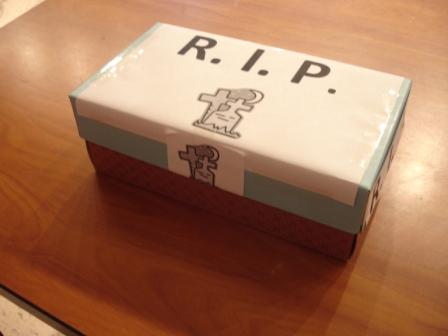
RIP: Bad Mondays
I have found week after week, month after month that my students REALLY hate Mondays. Beyond being tired or lethargic or slow, Monday's classroom behavior is usually the all time low for the week.
I think the general funk is due to the difficult transition from home to school, to the changes in expectation placed on them and their general feeling of lack of control over their environment. In fact, I try not to introduce anything new (or talk very much) on Mondays. I have ranted and raved in the past on the subject, to no avail. My students' external locus of control (is my ed psych professor smiling?) simply does not usually allow them to take power over such circumstance such as the day of the week.
So, after an especially frustrating class this Monday, I decided to try something NEW. Part of the idea came from somewhere on the Incredible Art Dept (if you know where exactly, please share!) for students who have a habit of saying, "I Can't".
First, students wrote or drew three reasons why Mondays are terrible. The paper was then folded in half, and they wrote "BAD MONDAYS" on it. Next we read with partners two pages of suggestions I printed off the internet to make Monday a better day (go to bed early, stop for a better breakfast, pick out a cuter outfit, etc.). We shared the suggestions and students even had some of their own! Then we tore the bad monday papers up, put them into a quick coffin I made:) and laid bad mondays to rest...complete with me humming Taps.
I will not pretend that this has transformed classroom behavior in a day, but perhaps some students will think it over and allow it to change their current pattern of thinking... Well I can hope can't I?
I think the general funk is due to the difficult transition from home to school, to the changes in expectation placed on them and their general feeling of lack of control over their environment. In fact, I try not to introduce anything new (or talk very much) on Mondays. I have ranted and raved in the past on the subject, to no avail. My students' external locus of control (is my ed psych professor smiling?) simply does not usually allow them to take power over such circumstance such as the day of the week.
So, after an especially frustrating class this Monday, I decided to try something NEW. Part of the idea came from somewhere on the Incredible Art Dept (if you know where exactly, please share!) for students who have a habit of saying, "I Can't".
First, students wrote or drew three reasons why Mondays are terrible. The paper was then folded in half, and they wrote "BAD MONDAYS" on it. Next we read with partners two pages of suggestions I printed off the internet to make Monday a better day (go to bed early, stop for a better breakfast, pick out a cuter outfit, etc.). We shared the suggestions and students even had some of their own! Then we tore the bad monday papers up, put them into a quick coffin I made:) and laid bad mondays to rest...complete with me humming Taps.
I will not pretend that this has transformed classroom behavior in a day, but perhaps some students will think it over and allow it to change their current pattern of thinking... Well I can hope can't I?
Sunday, February 27, 2011
Student Teachers: For Your Eyes Only
I recently replied to a student (art) teacher's comment on another blog and it got me thinking about my own student teaching experience and all i learned along the way...Sooo, I thought I'd revisit those gleanings as a post for student teachers.
My advice is as follows:
1) You are a guest.
My dear friend, do not create undue stress for yourself by trying to tackle all of the classroom issues on your own. This is practice for you, do not tire yourself out for the 'big game' that is your impending career. I say this as a self-proclaimed intense person. Please remember that no matter how effective/polished/inefficient/slap-dash/strict/orderly/messy, (whatever!) your mentor teacher seems to you, he/she has found a way that works FOR THEM, and it has developed over a period of time. It does not have to work for you, take it with a grain of salt. Try to figure out what led him/her to his/her present methods. Why might it work/not work for you? A good house guest makes the bed after themselves and doesn't take the liberties a family member does...Be helpful, but remember you are NOT a student OR the teacher. It's a learning experience, be there in the moment for that purpose.
2) Observe and Report
If it's not part of your teacher-training, keep a journal! Write about your Mentor teacher's interactions, style, instructional strategies; compare to what you learn in your ed classes and to your own intuition. This is a time to reflect on YOU and plan for your future teaching. When you begin your first year of teaching, it will be hard to find the time to gather such information. It will also be helpful to have a written record to go back to. Start lists of websites, inspirational artists, lesson plan ideas, useful bits of info from ed. textbooks:)
The more inspired you are to teach, the more inspiring you will be to your students.
3) COMMUNICATE
Knowledge is power, both for you and your mentor teacher. Be open (but professional!) about your take on strategies, management, etc. ASK questions, be open to new ideas from all angles. Be a team, it's an awesome advantage to have TWO teachers in the room! Use it- devise plans of attack, divide tasks, ask for help. Try to remember what it felt like being in the students' place. Talk to your students, especially if they are older, about their learning and expectations. Keep your college professor/supervisor in the loop! He/she is a WEALTH of information, but super busy, so ASK for resources, and if you need it, guidance!
4) Steal, steal, steal!
Photograph everything- posters, projects, organizational methods, the room. These are from my own student teaching experience:) Ask for copies, most teachers are happy to share. I still use the lesson plan template shared with me during student teaching.
*Thanks to Beth Spann, Kristin Plambeck, Christine Hoffman, MaryAnn Popovich, Darlene O'Donnell and Mary Hastings for making my student-teaching experience meaningful.
My advice is as follows:
1) You are a guest.
My dear friend, do not create undue stress for yourself by trying to tackle all of the classroom issues on your own. This is practice for you, do not tire yourself out for the 'big game' that is your impending career. I say this as a self-proclaimed intense person. Please remember that no matter how effective/polished/inefficient/slap-dash/strict/orderly/messy, (whatever!) your mentor teacher seems to you, he/she has found a way that works FOR THEM, and it has developed over a period of time. It does not have to work for you, take it with a grain of salt. Try to figure out what led him/her to his/her present methods. Why might it work/not work for you? A good house guest makes the bed after themselves and doesn't take the liberties a family member does...Be helpful, but remember you are NOT a student OR the teacher. It's a learning experience, be there in the moment for that purpose.
2) Observe and Report
If it's not part of your teacher-training, keep a journal! Write about your Mentor teacher's interactions, style, instructional strategies; compare to what you learn in your ed classes and to your own intuition. This is a time to reflect on YOU and plan for your future teaching. When you begin your first year of teaching, it will be hard to find the time to gather such information. It will also be helpful to have a written record to go back to. Start lists of websites, inspirational artists, lesson plan ideas, useful bits of info from ed. textbooks:)
The more inspired you are to teach, the more inspiring you will be to your students.
3) COMMUNICATE
Knowledge is power, both for you and your mentor teacher. Be open (but professional!) about your take on strategies, management, etc. ASK questions, be open to new ideas from all angles. Be a team, it's an awesome advantage to have TWO teachers in the room! Use it- devise plans of attack, divide tasks, ask for help. Try to remember what it felt like being in the students' place. Talk to your students, especially if they are older, about their learning and expectations. Keep your college professor/supervisor in the loop! He/she is a WEALTH of information, but super busy, so ASK for resources, and if you need it, guidance!
4) Steal, steal, steal!
Photograph everything- posters, projects, organizational methods, the room. These are from my own student teaching experience:) Ask for copies, most teachers are happy to share. I still use the lesson plan template shared with me during student teaching.
*Thanks to Beth Spann, Kristin Plambeck, Christine Hoffman, MaryAnn Popovich, Darlene O'Donnell and Mary Hastings for making my student-teaching experience meaningful.
Friday, February 18, 2011
lesson plan: using a sketchbook
I developed this lesson for several reasons... First of all I hoped students would form a bond with their sketchbook that they'll be using all semester. I also wanted them to be comfortable writing, drawing and collaging in the same space. And as an added bonus, students are exposed to the beauty and wonder of the world outside of their small community in the city through National Geographic.
As 7th and 8th graders I think it's really valuable for to take in new information and be able to utilize it, especially in their ART!
This is Part One of the lesson. Students are required to look through National Geographic magazines and find a picture of something beautiful, something weird, something scary and something they'd like to see in person. Then they label the pictures accordingly and write a sentence or two about what they found.
I really love the thoughtfulness behind this student's responses:)
The above page is Part Two of the assignment...Students select a theme from a list and fill one entire sketchbook page according to their theme, combining words and pictures together.
I stress to students that, "you'll only get out of this lesson what you put into it!" Some students get more out of it than others:)
Be ready for lots of discussion and noise as students discover weird, scary, awesome people/places/things outside of their comfort zone! It's so fun to observe!
Thursday, February 17, 2011
Not yet a well oiled machine...
What have I learned in my two years of teaching in an urban (art) classroom?
Be prepared. Be very prepared.
I'm posting some pictures of methods I've developed to deal with an assortment of issues. Like new students transferring in...like students returning from 3, 5, 7 days of suspension...like 25 students vying for my attention not so patiently...like students who may not know how to spend free time constructively
A daily reminder taped to my desk:)
How do you stay organized?
Be prepared. Be very prepared.
I'm posting some pictures of methods I've developed to deal with an assortment of issues. Like new students transferring in...like students returning from 3, 5, 7 days of suspension...like 25 students vying for my attention not so patiently...like students who may not know how to spend free time constructively
I put together this binder of information I go over as a Powerpoint at the beginning of the semester. I am also making a student information sheet to fill out and that indicates that the student read and understands our rules/procedures.
Students check this binder when they return from an extended absence, read necessary information and complete worksheets, assignments, and/or extra credit to get caught up with concepts and the gradebook. Reteaching entire lessons and days of instruction became very time consuming when the rest of the class still needs direction, assistance, and affirmation.
I am quickly closing all gaps which leave me open to students claiming they don't what is required/expected. Saying it is not enough, so I cover my bases!
A daily reminder taped to my desk:)
How do you stay organized?
Subscribe to:
Posts (Atom)